

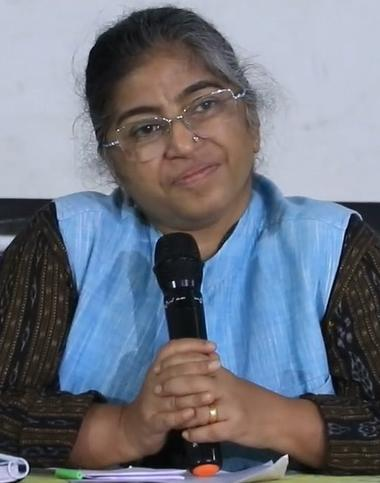
A week after the Supreme Court delivered a landmark judgment establishing a nationwide Victim Protection Plan for survivors of sex trafficking, Prajwala founder and Padma Shri awardee Sunitha Krishnan addressed the media in Hyderabad to explain the verdict’s significance and respond to what she described as misleading interpretations in sections of the media.
Calling the verdict the culmination of a 22-year legal battle fought on behalf of trafficking survivors, Krishnan expressed concern that much of the public discussion had shifted towards questions surrounding voluntary sex work while overlooking the case’s central purpose. “Don’t reduce 22 years of struggle to a debate on sex work,” she said. “This case was fought for trafficking survivors. It was fought for their dignity, rehabilitation, protection and rights.”
Joined by survivor leaders from Prajwala’s survivor collective Aparajita and senior Supreme Court advocate Aparna Bhat, who appeared virtually from New Delhi, Krishnan spent nearly an hour explaining the legal journey that led to the judgment, the provisions in the newly recognised Victim Protection Plan, and the challenges that still lie ahead in ensuring implementation.
For Krishnan, the story began not in 2026, but in 2004.
Working for decades with women and girls rescued from commercial sexual exploitation, Prajwala repeatedly encountered a troubling reality. Rescue operations were taking place, but survivors continued to face victimisation even after being brought out of brothels and trafficking networks. Many encountered stigma, neglect, bureaucratic indifference and repeated exploitation through institutional processes.
This experience led Prajwala to file a Public Interest Litigation before the Supreme Court in 2004 seeking a national Victim Protection Protocol for survivors of sex trafficking.
“We rescued more than 32,000 girls and women. What we kept seeing was that rescue alone was not enough. Even after rescue, survivors continued to face stigma, neglect, exploitation and repeated victimisation,” Krishnan said.
The legal battle that followed would span more than two decades.
According to Krishnan and Aparna Bhat, the matter was disposed of twice after assurances from the Union Government that substantial reforms would be introduced. In 2015, the Government assured the Court it would bring a comprehensive anti-trafficking law and establish a specialised Organized Crime Investigation Agency to investigate trafficking networks.
Aparna Bhat explained that the demand for a specialised investigative agency arose from the nature of trafficking itself.
Trafficking, she noted, is organised crime. It often spans multiple districts, states and, in some cases, international borders. Local police stations frequently lack the jurisdictional reach and specialised resources required to dismantle trafficking networks operating across multiple regions. Prajwala therefore argued for a specialised agency capable of coordinating investigations across jurisdictions and addressing trafficking as organised crime rather than isolated offences.
Although committees were formed, consultations conducted and draft bills prepared, implementation remained elusive. At one stage, an anti-trafficking bill was passed in the Lok Sabha, creating optimism that comprehensive reform was imminent. However, the bill later lapsed before passage in the Rajya Sabha.
With promised reforms failing to materialise, Prajwala returned to the Supreme Court in 2017. Further assurances followed. Yet implementation remained absent. In 2022, Prajwala approached the Court once more, arguing that the commitments made before the judiciary had still not been fulfilled. When hearings resumed in 2024, the Government argued that provisions under the Bharatiya Nyaya Sanhita were sufficient and that a separate anti-trafficking law was unnecessary. The litigation subsequently culminated in the present judgment.
“Our position has remained consistent since 2004. Victims of trafficking need a structured protection framework from the moment they come into contact with the State during rescue until they are fully rehabilitated and reintegrated,” Bhat explained.
Krishnan described the May 29 judgment as a historic turning point because, for the first time in independent India’s history, the judiciary explicitly recognised the trauma and lived realities of sex trafficking survivors and established a detailed Victim Protection Plan.
“For the first time in 77 years of Independence, the judiciary has acknowledged the trauma and suffering of survivors of sex trafficking,” she said.
The framework, she explained, covers the entire continuum of care and protection, including rescue, immediate support, rehabilitation, legal aid, reintegration and long-term recovery. It assigns responsibilities to various stakeholders and introduces accountability mechanisms for institutions responsible for assisting survivors.
Among the most significant provisions, Krishnan said, is the recognition of rehabilitation as a right.
“Rehabilitation is not charity. Rehabilitation is a right.”
For the first time, rehabilitation has been explicitly linked to Articles 21 and 23 of the Constitution, recognising it as an entitlement flowing from the rights to life, dignity and freedom from exploitation.
Another major contribution of the judgment, according to Krishnan, is its definition of dignity.
The Court identifies three core elements. A survivor must not be treated as a commodity. She must be recognised and treated with respect. And she must be provided the material conditions necessary to lead a meaningful life.
“Only when all three are present can dignity be realised,” Krishnan explained.
The judgment also recognises survivor consent as a critical element of rehabilitation. Decisions concerning rehabilitation and reintegration must take into account the survivor’s wishes and choices. Magistrates are required to hear and consider the views of survivors throughout the process while ensuring that coercion and intimidation are properly examined.
Krishnan further highlighted provisions guaranteeing legal representation for survivors.
“For the first time, every victim has the right to legal representation. The State must ensure that survivors have access to a lawyer.”
The judgment also introduces important accountability measures.
For years, Anti-Human Trafficking Units (AHTUs) have functioned primarily as rescue teams with limited powers after survivors were handed over to local police. Krishnan explained that the new framework directs that Anti-Human Trafficking Units be notified as police stations, enabling them to play a more substantial role in investigation and follow-up action.
“We have been demanding stronger Anti-Human Trafficking Units for years because trafficking is organised crime. This judgment gives them a far more meaningful role.”
Another provision Krishnan repeatedly emphasised concerns compensation.
For years, adult survivors of sex trafficking often struggled to secure compensation despite participating in lengthy criminal proceedings and providing testimony against traffickers.
“This judgment clearly says that adult victims of sex trafficking have a right to compensation. Compensation is now mandatory.”
The judgment also contains recommendations extending beyond the Victim Protection Plan itself.
One recommendation calls upon the Government of India to consider a comprehensive anti-trafficking law addressing all forms of trafficking, not merely trafficking for commercial sexual exploitation. Another urges attention to cyber-enabled and technology-facilitated trafficking, reflecting concerns raised through national research and consultations.
Krishnan noted that trafficking today increasingly operates through social media platforms, digital networks and online recruitment systems, creating new vulnerabilities that existing frameworks must address.
A substantial portion of the press conference focused on clarifying public confusion surrounding the judgment’s observations regarding voluntary adult sex work.
Krishnan argued that several media reports had incorrectly framed the verdict as being primarily about voluntary sex work.
“This judgment is about trafficking survivors,” she said repeatedly.
Explaining the Court’s reasoning, she said the judgment acknowledges that spaces associated with prostitution may contain different categories of individuals: trafficked persons, individuals who were trafficked but have become normalised within exploitative environments, and persons who may be voluntarily engaged in sex work.
Importantly, Krishnan stressed, the judgment does not prohibit rescue operations.
“When a rescue happens, everyone may tell the same story. In our experience, the truth often emerges only later.”
The judgment therefore provides a process under which individuals are brought before a magistrate, placed in safe accommodation and subjected to a threshold inquiry supported by professional social work assessments before final determinations are made.
“Rescue is not stopped. Rescue happens. Inquiry happens afterwards.”
While legal and policy discussions formed a major part of the briefing, the most powerful moments of the press conference came when survivor leaders themselves addressed the media.
Representing different regions of the country and different journeys through trafficking and recovery, Nazia from West Bengal, Sujata Pradhan from Odisha, Shravanthi from Rajahmundry and Siraj from Chittoor shared their experiences of trafficking, rescue, rehabilitation and rebuilding their lives.
Their testimonies transformed what had been a discussion about law and policy into a conversation about lived realities.
Nazia spoke about the need for stronger anti-trafficking investigations and specialised mechanisms capable of responding more effectively to survivors’ needs. Having experienced the system firsthand, she expressed hope that stronger Anti-Human Trafficking Units would lead to greater accountability and better outcomes for survivors.
Sujata Pradhan reflected on how rehabilitation helped her rebuild her life with dignity and independence. She said meaningful support, opportunities and sustained intervention had played a crucial role in helping survivors move beyond exploitation and reclaim their futures.
Among the survivor testimonies, Shravanthi’s remarks offered one of the clearest illustrations of what rehabilitation actually means in practice.
Originally from Rajahmundry, she recounted how she was deceived and trafficked into commercial sexual exploitation before being rescued by police and referred to Prajwala through court orders.
“Because I received proper rehabilitation, I am able to stand before you today and speak with dignity,” she said.
She explained that rehabilitation is far more than food and shelter. It includes education, healthcare, life skills, vocational training, livelihood opportunities and the support necessary to rebuild an independent life.
“Rehabilitation is not simply eating and staying somewhere. It is learning skills, receiving healthcare, education and support to live independently.”
Today, years after her rescue, Shravanthi works with rehabilitation programmes herself, helping other survivors navigate journeys similar to her own. She also highlighted the role survivor consultations played in shaping the framework, noting that recommendations gathered through meetings and video conferences with survivors were ultimately considered during the legal process.
Siraj, trafficked from Chittoor, spoke about how rehabilitation and vocational training enabled her to build a livelihood and regain confidence. She welcomed the new framework’s focus on employment opportunities, self-reliance and long-term support for survivors.
Krishnan noted that survivor participation had been central throughout the 22-year legal battle.
Over the years, national consultations were conducted with survivors from across India to understand their experiences and gather recommendations regarding protection, rehabilitation and compensation. Many of these concerns ultimately found reflection in the final framework.
“The people who understand trafficking best are those who have survived it,” Krishnan said. “Their voices shaped this struggle and their experiences shaped this judgment.”
Twenty-two years after Prajwala first approached the Supreme Court seeking a protection framework for trafficking survivors, the judgment has finally arrived. Yet, as Sunitha Krishnan repeatedly reminded those gathered at the press conference, the verdict is not the destination but the beginning of a new responsibility. For the women who sat beside her – survivors who once entered the system as victims and now stand as leaders, advocates and contributors to shaping policy – the significance of the judgment lies in what happens next. Whether its promises reach every rescue operation, every shelter home and every survivor seeking a second chance will determine its true legacy. “Bringing this judgment was a struggle. Implementing it will be another struggle,” Krishnan said, leaving a reminder that the fight for dignity, rehabilitation and justice does not end with a verdict – it begins with its implementation.

