

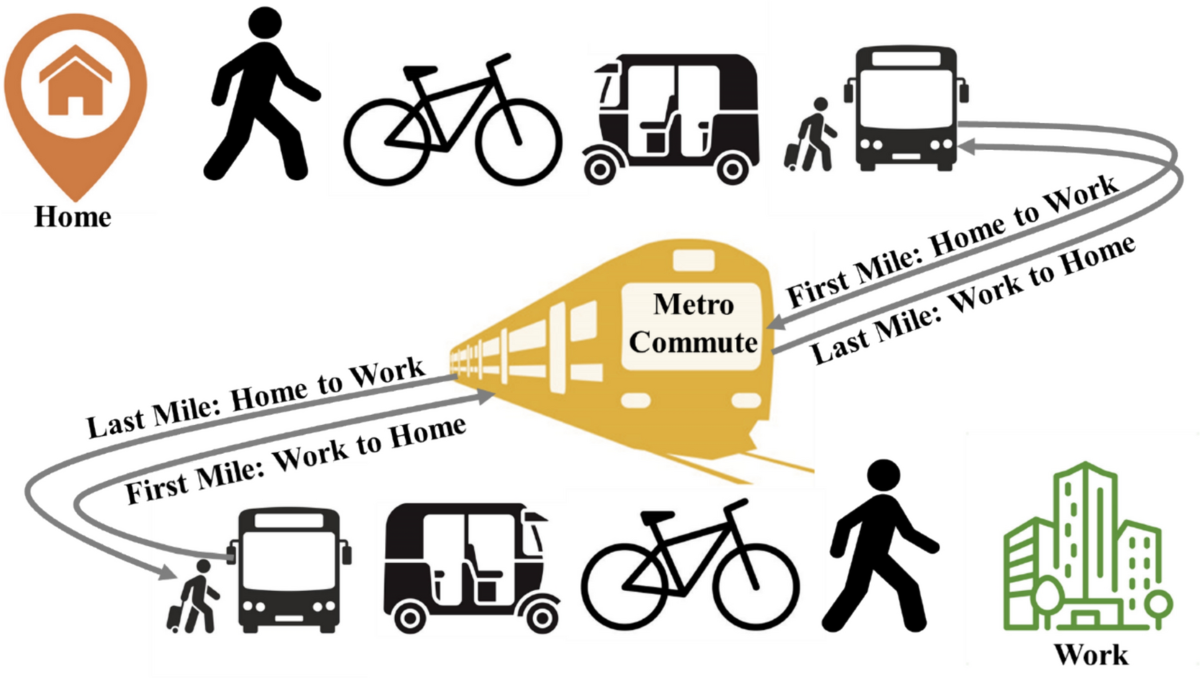
While metro rail systems have revolutionized urban public transit in India, the effectiveness of this mass transport backbone is often undermined by a persistent problem: poor last-mile connectivity. The “last mile” refers to the distance and travel mode between a metro station and a commuter’s final destination (or vice-versa, the “first mile”). When this gap isn’t bridged efficiently, safely, and affordably, commuters revert to private vehicles, defeating the metro’s purpose.
Major Issues in Last-Mile Connectivity
Several challenges prevent seamless integration of metro systems with the surrounding urban environment:
* Inadequate Feeder Services: Reliance on informal para-transit (auto-rickshaws, cycle-rickshaws) is common, but official feeder bus services are often insufficient, infrequent, or lack coverage in residential and commercial hubs located just outside the station’s immediate walking radius.
* Poor Non-Motorized Transport (NMT) Infrastructure:
* Lack of Walkability: Footpaths near stations are frequently encroached upon by vendors, are poorly maintained, or are non-existent, making walking unsafe, especially for women, children, and the elderly.
* Unsafe Crossings: Difficulty in crossing busy roads outside stations due to heavy traffic and lack of safe pedestrian crossings (e.g., FOBs or subways).
* Cycling Deficiencies: Absence of dedicated cycling lanes and secure bike parking facilities discourages the use of bicycles or shared micro-mobility options.
* Lack of Integration and Coordination: There is often a disconnect in planning and operations between the Metro Rail Corporation, local Municipal Corporations, and State Road Transport Undertakings (SRTUs). This leads to:
* Disparate Ticketing: Lack of a unified ticketing system (like the National Common Mobility Card – NCMC) that works across the metro, feeder buses, and other modes.
* No Integrated Schedules: Feeder services rarely synchronize their schedules with metro train arrivals and departures.
* Safety and Security Concerns: Inadequate lighting and police presence, particularly late at night, make the final journey challenging, especially for women commuters.
* Informal Para-Transit Chaos: While auto-rickshaws are vital, their operation is often unregulated, leading to overcharging, refusal of short-distance rides, and chaotic parking, creating congestion at station exits.
Solutions for Seamless Last-Mile Connection
Addressing the last-mile problem requires a comprehensive, multi-modal, and integrated approach:
1. Robust and Integrated Feeder Systems
* Automatic Feeder Permits: Streamlining the process for metro entities to run their own feeder bus services by granting automatic permits under transport regulations.
* Electric Micro/Mini Buses: Introducing frequent, compact electric microbuses that can navigate narrow city streets and offer clean, dedicated services within a 5-kilometre radius of the station.
* Single/Common Ticketing: Fully implementing the National Common Mobility Card (NCMC) or QR-code systems for seamless payment across the metro, feeder buses, and authorized shared mobility.
2. Enhancing Non-Motorized Transport (NMT)
* Prioritizing Pedestrian Corridors: Ensuring continuous, shaded, and safe footpaths within a 500-meter catchment area of every station, free from encroachment.
* Dedicated Cycling Infrastructure: Providing dedicated cycle lanes and secure, covered bicycle and e-bike parking at station premises.
* Improving Access: Constructing well-lit Foot Overbridges (FOBs) or subways to connect stations to key adjacent high-rise buildings, commercial centres, and bus stops, separating pedestrian traffic from vehicular flow.
3. Smart & Shared Mobility Solutions
* Regulated Shared E-Mobility: Promoting the deployment of regulated electric three-wheelers (e-rickshaws), e-bikes, and bike-taxis by creating designated, organized pick-up/drop-off points and parking bays near the exits.
* App Integration: Collaborating with private ride-sharing aggregators and public transport apps to provide real-time information and booking for various last-mile options, allowing commuters to plan their end-to-end journey.
* Transit-Oriented Development (TOD): Implementing policies that integrate land use and transport planning, allowing for high-density mixed-use development within walking distance of metro stations to naturally reduce last-mile travel needs.
4. Institutional and Policy Reforms
* Unified Metropolitan Transport Authority (UMTA): Establishing a single body to coordinate the planning and operations of all modes of transport in a city—metro, buses, autos, and taxis—to ensure consistency and resource allocation for last-mile needs.
* Mandatory Last-Mile Budgeting: Mandating that metro Detailed Project Reports (DPRs) allocate a specific percentage of their budget (e.g., 10%) for integrated last-mile infrastructure and services.
By implementing these solutions, Indian metros can truly become the artery of urban mobility, encouraging a greater shift away from private vehicles and delivering on the promise of safe, sustainable, and inclusive public transport.

