

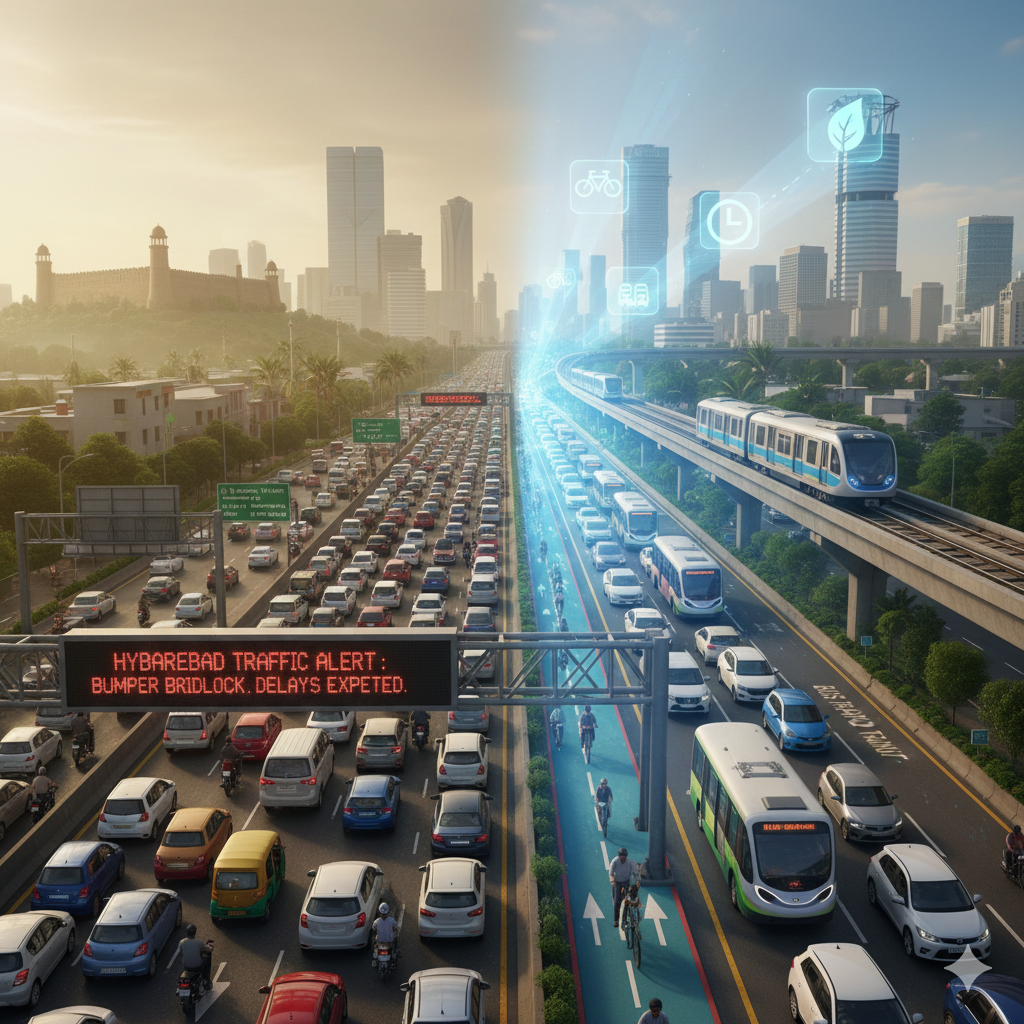
Hyderabad, once celebrated for its tranquil charm and burgeoning IT landscape, is increasingly grappling with a challenge that threatens to overshadow its economic success: debilitating, bumper-to-bumper traffic. The daily commute has become a grueling test of patience, impacting productivity, the environment, and the overall quality of life for its millions of residents.
The Anatomy of a Gridlock
Several factors converge to create Hyderabad’s notorious traffic jams:
Explosive Urbanization and Population Growth: The city’s rapid expansion, driven by its status as a tech and pharmaceutical hub, has led to an influx of population that infrastructure has struggled to keep pace with.
Vehicle Proliferation: With rising disposable incomes, personal vehicle ownership has skyrocketed. The sheer volume of cars, bikes, and autos on the roads far exceeds their carrying capacity.
Inadequate Public Transport
Infrastructure (Historically): While strides are being made, past underinvestment in comprehensive public transport systems forced many to rely on personal vehicles. The Metro, though a game-changer, still doesn’t cover all critical arteries comprehensively.
Narrow Roads and Choke Points: Many older parts of the city, and even some newer areas, feature roads that simply aren’t wide enough to handle the current traffic density. Intersections often become major bottlenecks.
Lack of Parking Discipline: Illegal parking on main roads further reduces road capacity, exacerbating congestion.
Dispersed Work Zones: While IT corridors are concentrated, residential areas are spread across the city, leading to long commutes and concentrated traffic flows towards these economic hubs.
Poor Road User Behavior: Lane indiscipline, aggressive driving, and disregard for traffic rules contribute significantly to chaotic conditions and slow movement.
Ongoing Infrastructure Projects: While necessary for long-term improvement, current construction of flyovers, underpasses, and road widening projects often creates temporary bottlenecks and diversions.
The consequences are stark: lost economic productivity, increased fuel consumption and air pollution, higher stress levels among commuters, and a tangible dip in the city’s liveability index.
Solutions to Untangle the Mess
Addressing Hyderabad’s traffic woes requires a multi-pronged, sustained, and integrated approach involving urban planners, government agencies, technology, and public cooperation.
Strengthening and Expanding Public Transportation:
Metro Expansion: Continue extending Metro rail lines to cover more residential and commercial hubs, ensuring last-mile connectivity with feeder services (electric autos, share taxis, mini-buses).
Enhanced Bus Services: Revitalize RTC services with modern, comfortable, and frequent buses on dedicated lanes where feasible. Introduce more express routes and improve real-time tracking.
Integrated Ticketing: A single ticketing system for Metro, buses, and potentially even MMTS (Multi-Modal Transit System) trains would simplify public transport usage.
Promoting Non-Motorized Transport (NMT):
Dedicated Cycle Lanes: Create safe, continuous, and well-maintained cycle tracks, especially in residential and educational zones, encouraging cycling for short distances.
Pedestrian-Friendly Infrastructure: Improve footpaths, ensure proper lighting, and create safe pedestrian crossings to encourage walking.
Intelligent Traffic Management Systems (ITMS):
Adaptive Traffic Signals: Implement AI-powered signals that adjust timings based on real-time traffic flow, rather than fixed schedules.
CCTV Surveillance and Enforcement: Utilize technology to monitor violations and enforce traffic rules more effectively, including automated challans for lane cutting, jumping signals, and illegal parking.
Variable Message Signs (VMS): Provide real-time updates on traffic conditions, diversions, and travel times to help commuters make informed decisions.
Urban Planning and Road Infrastructure:
Flyovers and Underpasses: Continue strategic construction of grade separators at major intersections, but with a focus on ensuring smooth traffic flow post-construction.
Road Widening and Improvement: Identify and widen critical arterial roads where feasible, removing encroachments.
Ring Roads and Peripheral Connectivity: Leverage Outer Ring Road (ORR) and build Inner Ring Roads to distribute traffic away from the city center.
Parking Management: Implement smart parking solutions, multi-level parking facilities, and strict enforcement against illegal parking. Consider dynamic pricing for parking to discourage personal vehicle use in congested areas.
Policy Interventions and Behavioral Change:
Congestion Pricing/Road Pricing: While politically sensitive, this involves charging vehicles for entering congested areas during peak hours, a proven method globally to reduce traffic.
Work-From-Home (Hybrid Models): Encourage companies to adopt hybrid work models where feasible, reducing the number of commuters on roads daily.
Staggered Office Timings: Encourage businesses to adopt staggered work hours to spread out peak hour traffic.
Public Awareness Campaigns: Educate citizens on traffic rules, lane discipline, the benefits of public transport, and the environmental impact of personal vehicle use.
Carpooling and Ride-Sharing Incentives: Promote and incentivize carpooling platforms and ride-sharing services.
The Road Ahead
Hyderabad’s traffic problem is complex, but not insurmountable. It requires bold leadership, significant investment, technological integration, and critically, a fundamental shift in commuter behavior. By prioritizing efficient public transport, embracing smart traffic solutions, and encouraging sustainable mobility choices, Hyderabad can reclaim its reputation as a dynamic, liveable city and ensure that its growth is not stalled by gridlock. The future of the ‘City of Pearls’ depends on how effectively it untangles its traffic knots.

