

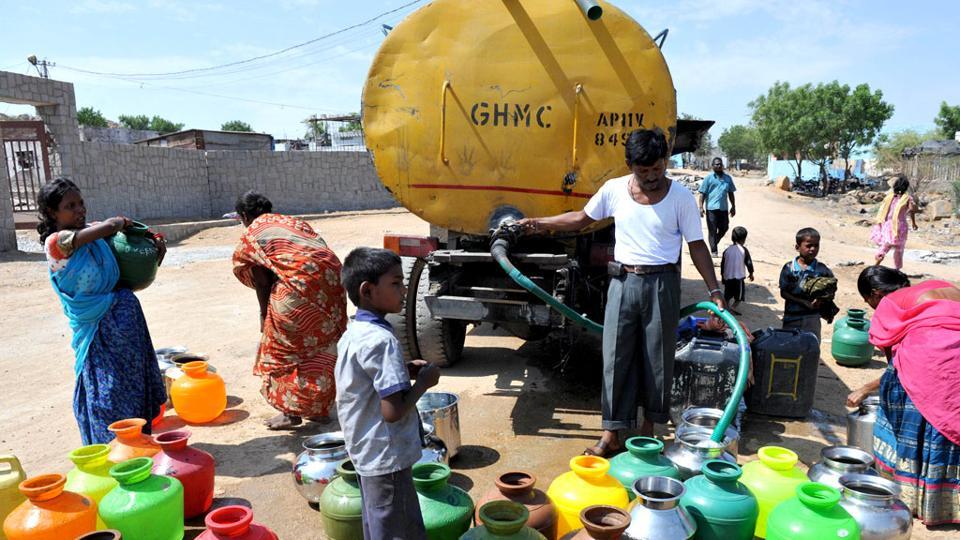
As of early 2026, Hyderabad is navigating a complex water landscape. While the city has made significant strides in piped water coverage, it faces a “silent crisis” driven by rapid urbanization, pollution of local reservoirs, and a plummeting groundwater table.
The Potable Water Crisis in Hyderabad (2026)
The city’s water woes are no longer just about “scarcity” but are increasingly about quality and sustainability.
1. Contamination of Primary Sources
Recent studies in 2026 have revealed that four of Hyderabad’s six major drinking water sources—Osmansagar, Himayatsagar, Godavari, and Krishna—are critically polluted.
* The Cause: Untreated sewage and industrial effluents from surrounding residential and industrial hubs (like Medak) flow directly into these reservoirs.
* The Risk: High levels of fecal coliform and heavy metals like cadmium and lead have been detected, pushing the Water Quality Index (WQI) to “very poor” levels.
2. Groundwater Depletion (The “Red Zone”)
By January 2026, groundwater levels in several mandals—including Ameerpet, Kukatpally, and Bachupally—have dropped into the “red zone,” with water tables falling below 20 meters.
* Urban Heat & Concrete: Rapid construction has paved over natural recharge zones, meaning even a good monsoon fails to replenish the aquifers.
* Over-extraction: The mushrooming of illegal borewells in high-rise corridors has led to a drop of 2-3 feet in groundwater levels compared to the previous year.
3. Aging Infrastructure
Nearly 35-40% of the city’s water is lost during distribution. This is due to corroded, decades-old pipelines that suffer from frequent leakages. Often, these water lines run dangerously close to sewerage networks, leading to cross-contamination.
Strategic Solutions and the 2026 Action Plan
The Hyderabad Metropolitan Water Supply and Sewerage Board (HMWSSB) and the state government have initiated several multi-pronged strategies to combat these issues.
Infrastructure & Supply Expansion
* Godavari Phase 2: A ₹7,000 crore project is underway to bring additional Godavari water to the city, aiming for a year-round, 24/7 supply by late 2027.
* Smart Monitoring: The installation of flow meters and IoT-based sensors to detect “hidden leaks” and eliminate illegal connections is being scaled up across the GHMC area.
Groundwater Recharge: “One House, One Recharge Pit”
To combat the falling water table, the government has mandated:
* Mandatory Recharge Pits: Every house built on 200 sq. yards or more must have a rainwater harvesting pit.
* Injection Borewells: Converting thousands of defunct borewells into injection wells to channel rainwater directly into the ground.
Ecosystem Restoration
* Musa River Revival: Phase 1 of the Musi River restoration (starting March 2026) aims to clean a 21 km stretch, reducing the toxic load on the city’s ecosystem.
* Lake Protection (TDR Policy): New policies offer “Transferable Development Rights” to landowners who surrender land for lake conservation, incentivizing the protection of buffer zones from encroachment.
Decentralized Solutions
Educational institutions like IIIT-Hyderabad and MANUU have set a blueprint for the city. By creating biodiversity ponds and recycling 100% of their “gray water” for landscaping, these campuses have become nearly “net-zero” in water consumption, avoiding tankers even in peak summer.
The path to a water-secure Hyderabad lies in moving away from a “tanker-dependent” mindset toward one of circular water management—where every drop is harvested, treated, and reused.

