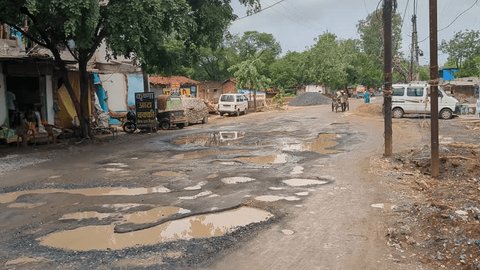

India lives in its villages. Nearly two-thirds of the population resides in rural areas, and their economic survival depends heavily on connectivity. Yet, in many parts of the country, rural roads remain broken, poorly maintained, waterlogged, or completely unusable during monsoons. Despite flagship schemes like Pradhan Mantri Gram Sadak Yojana (PMGSY), the ground reality in several districts reveals a stark contrast between policy intent and actual conditions.
The Reality of Rural Roads
In numerous villages:
Roads are unpaved or poorly constructed.
Monsoon rains turn them into muddy tracks.
Drainage systems are absent or clogged.
Potholes make transportation slow and dangerous.
Maintenance is irregular or nonexistent.
While new roads are often constructed under central schemes, maintenance responsibility shifts to local authorities, where funding and accountability gaps frequently lead to rapid deterioration.
Impact on Rural Livelihoods
1. Agriculture and Market Access
Farmers depend on roads to transport produce to mandis (markets). Poor roads:
Increase transport costs.
Cause delays, leading to spoilage of perishable goods like vegetables and milk.
Reduce farm-gate prices because traders factor in transport risks.
This directly lowers rural incomes and discourages crop diversification.
2. Employment and Migration
Inadequate roads limit:
Access to nearby towns for work.
Mobility for daily wage earners.
Opportunities for rural youth seeking jobs or skill training.
As a result, distress migration increases, pushing people toward overcrowded urban centers.
3. Education Disruptions
Children often struggle to reach schools during rainy seasons. In many areas:
School buses avoid damaged routes.
Attendance drops during monsoons.
Girls are disproportionately affected due to safety concerns.
Long-term, this impacts human capital development.
4. Healthcare Access
Emergency healthcare becomes a nightmare when ambulances cannot reach villages. Pregnant women, accident victims, and elderly patients suffer delays that can be fatal. A basic right to healthcare becomes inaccessible due to simple infrastructure failure.
5. Small Businesses and Rural Entrepreneurship
Poor connectivity:
Raises logistics costs.
Discourages investors from setting up rural enterprises.
Limits tourism potential in scenic rural areas.
Without reliable roads, rural India cannot fully integrate into the broader economy.
National-Level Consequences
1. Economic Loss
When agricultural produce cannot reach markets efficiently, the entire supply chain suffers. Inflation may rise due to artificial shortages. Logistics inefficiencies reduce India’s overall competitiveness.
2. Increased Urban Pressure
Poor rural infrastructure accelerates migration to cities like Mumbai, Delhi, and Hyderabad, leading to:
Slum expansion
Traffic congestion
Urban unemployment
Balanced regional development becomes impossible without rural connectivity.
3. National Security and Disaster Response
In border and tribal areas, bad roads hamper:
Military logistics
Disaster relief operations
Administrative reach
Connectivity is not just a development issue—it is strategic.
Why Are Rural Roads Still in Poor Condition?
1. Poor construction quality due to corruption or weak supervision.
2. Lack of maintenance budgets after initial construction.
3. Heavy vehicle misuse beyond designed load capacity.
4. Climate challenges, especially flooding and extreme heat.
5. Fragmented accountability between central, state, and panchayat bodies.
Solutions: A Multi-Pronged Approach
1. Shift Focus from Construction to Maintenance
Allocate dedicated, ring-fenced maintenance funds for 10–15 years after construction. Performance-based maintenance contracts can ensure accountability.
2. Use Better Technology
Cold mix and all-weather road materials.
Geo-textiles for flood-prone areas.
Cement concrete roads in high-rainfall regions.
Durability must replace short-term cost-cutting.
3. Community Monitoring
Village-level monitoring committees can:
Report defects.
Track contractor performance.
Use digital grievance systems for transparency.
Social audits should be mandatory.
4. Strengthen Local Governance
Empower panchayats with:
Technical support.
Transparent budgeting tools.
Clear maintenance responsibilities.
5. Digital Mapping and Transparency
Public dashboards showing:
Road condition status.
Maintenance timelines.
Contractor details.
Technology can reduce corruption and improve oversight.
6. Integrate Rural Roads with Economic Planning
Road development should align with:
Agricultural clusters
Rural industrial corridors
Tourism circuits
Connectivity must support economic goals, not exist in isolation.
Conclusion
Rural roads are not just strips of asphalt—they are lifelines. They determine whether a farmer earns a fair price, whether a child reaches school, whether a patient survives, and whether a village prospers or declines.
India’s ambition to become a $5 trillion economy cannot succeed if its villages remain physically disconnected. Fixing rural roads is not charity—it is nation-building. Durable infrastructure, strict accountability, and long-term planning can transform rural connectivity from a recurring problem into a powerful driver of inclusive growth.
When rural roads improve, rural lives improve—and when rural India rises, the nation rises with it.
Pathetic Indian Rural Roads: Impact on Livelihoods and the Nation — and the Way Forward