

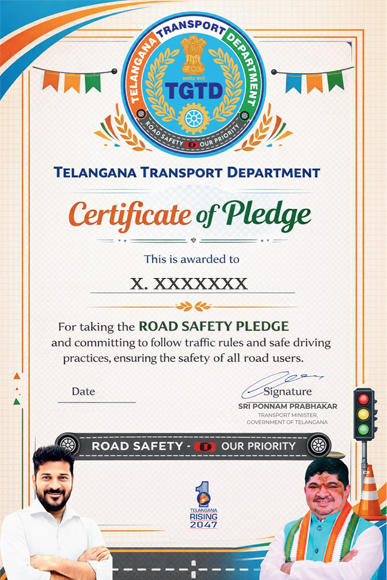
Poor Public Response to Taking the Telangana Road Safety Pledge: A Growing Concern
In early 2026, the Government of Telangana launched an online Road Safety Pledge campaign https://tgtransportpledge.com inviting citizens and parents across the state to commit to safer behaviour on the roads.
The initiative, led by Transport Minister Ponnam Prabhakar, was designed to instil a culture of responsibility, urging people to obey traffic rules, wear helmets and seat belts, avoid using mobile phones while driving, and never drink and drive. Participants could take the pledge online and download a personalised certificate to share and encourage others to follow suit.
The pledge campaign was widely promoted as a grassroots movement – one that would extend awareness beyond enforcement and into citizens’ everyday actions on the road. Families, particularly parents and children, were encouraged to pledge together as role models for safer road behaviour.
Low Participation Numbers Reflect Limited Public Engagement
Despite the official push, data from the pledge website suggests that public participation has been significantly lower than expected. As of now, only a few thousand citizens have taken the pledge, with even fewer parents participating. These figures, while a start, fall short of what might be expected in a state with millions of road users and widespread traffic challenges.
This modest engagement highlights a lack of widespread public interest or urgency among the general population, even though road safety remains a pressing issue in Telangana. Recent reports show that the state has identified a large number of accident-prone “black spots” on its National Highways, and overall road safety indicators continue to raise concern among experts.
Why Is Public Response Limited?
Several factors could be contributing to the poor public response:
- Awareness vs. Action Gap: While the campaign has been covered in media and government channels, the message may not have reached a broad cross-section of citizens in a way that motivates action. Many residents may not see an online pledge as a meaningful step in real-world safety.
- Behavioural Change is Hard: Encouraging people to change long-standing habits — like not wearing helmets, ignoring seat belt rules, or using phones while driving — requires more than signing a pledge. Without visible incentives, enforcement, or community-level follow-ups, pledges alone may feel symbolic rather than impactful.
- Competing Priorities: For many residents, daily concerns like commuting, work, and family responsibilities may outweigh participation in voluntary campaigns, particularly if they don’t see immediate benefits.
Wider Road Safety Challenges Point to the Need for Stronger Engagement
The issue of low participation in the Road Safety Pledge comes at a time when road safety remains a critical concern in Telangana. National data suggests that thousands of accidents occur across the state each year, with hundreds of fatalities. Road safety experts continue to call for a comprehensive approach involving education, enforcement, infrastructure improvements, and stronger community involvement.
Within this broader context, signing a pledge — while a positive step — cannot replace active behavioural change on the roads. Without stronger public engagement, regular reinforcement and follow-up programmes, the pledge risks becoming a symbolic gesture rather than a transformative movement.
What Needs to Change?
For the Road Safety Pledge to gain traction and truly impact road behaviour, several steps could help:
- Wider Community Outreach: Partnering with schools, colleges, employers, and local organisations to make the pledge a part of community activities rather than an online form.
- Linking Pledge to Practical Incentives: Offering tangible benefits — such as priority service or recognition in community forums — could motivate more people to participate.
- Ongoing Awareness Campaigns: Road safety messaging should be continuous, using social media, local media, and grassroots efforts to reinforce why safe behaviour matters.
The pledge remains a well-intentioned initiative that reflects the government’s commitment to educate and involve citizens in road safety. However, the limited response so far suggests that achieving behavioural change across Telangana will require deeper engagement, more compelling outreach, and sustained community involvement — beyond just taking a pledge online.

