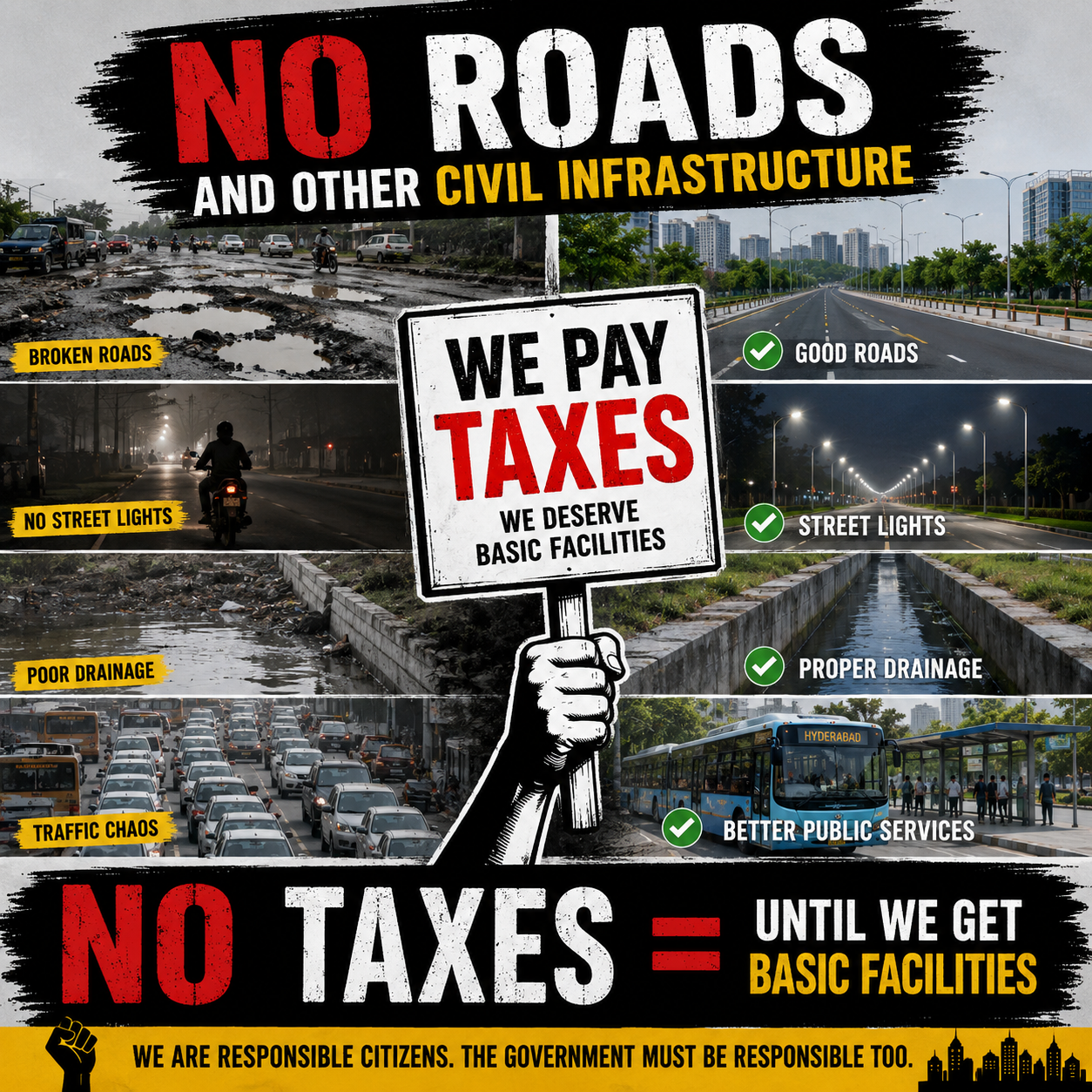

Hyderabad’s booming IT corridor may soon see a new form of citizen protest if a proposed campaign by employees and companies in the Hi-Tech City region gathers momentum: “No proper roads, streetlights and basic civic facilities — then why should citizens continue paying taxes?”
The proposal, reportedly being discussed among employees and companies’ representatives, reflects growing frustration over the condition of roads, inadequate street lighting, drainage problems, traffic bottlenecks, pedestrian safety and other basic infrastructure in parts of the city’s major technology corridors.
HITEC City is one of Hyderabad’s most important technology districts and has been central to the city’s transformation into a major IT and business hub.
Taxpayer expectations are simple
Employees working in Hyderabad’s IT sector pay income tax, professional tax and other statutory charges, while companies contribute through various taxes, fees and other payments. Residents also pay property tax, vehicle-related taxes and charges for municipal and public services.
The basic expectation, therefore, is straightforward: taxes should translate into functioning civic infrastructure.
Good roads are not a luxury for a city that wants to attract global companies. Streetlights are essential for employee safety, particularly for people travelling early in the morning or late at night. Proper drainage, footpaths, traffic management, waste collection and pedestrian facilities are equally important.
“We pay taxes, but what do we get?”
The proposed campaign could turn this frustration into a broader question for the government and civic authorities:
Where is the accountability for the taxes paid by citizens and businesses?
Employees travelling through damaged roads face increased travel times, vehicle maintenance costs and safety risks. Two-wheelers are particularly vulnerable when roads have potholes, inadequate lighting or poorly marked construction zones.
For companies, poor infrastructure can also affect employee productivity, transportation costs and the overall attractiveness of Hyderabad as a global business destination.
A tax boycott would be controversial
However, there is an important legal distinction.
Citizens cannot simply stop paying legally mandated taxes because civic services are inadequate. Such a move could result in penalties, interest or other legal consequences.
Therefore, rather than an actual tax default, the proposed campaign could potentially become a symbolic civic movement demanding accountability—through petitions, public consultations, RTI applications, grievance campaigns, social-media campaigns and representations to elected representatives and civic authorities.
The slogan could be:
“Pay taxes, demand services, demand accountability.”
Hyderabad cannot afford an infrastructure gap
The city has positioned itself as a major destination for technology companies, global capability centres and skilled professionals. That economic growth needs to be matched by equally strong urban infrastructure.
A technology employee working in a world-class office but travelling home on a poorly lit, damaged road represents a contradiction in Hyderabad’s development story.
The government and civic agencies therefore need to look beyond individual road repairs and adopt a planned infrastructure approach covering roads, storm-water drainage, street lighting, footpaths, traffic management, public transport and pedestrian safety.
A wake-up call for authorities
If the Hi-Tech City employees and companies’ forum proceeds with such a campaign, it could become an important test of how effectively Hyderabad responds to taxpayer concerns.
The message from taxpayers need not be anti-government. It can be a demand for better governance and measurable service delivery.
Citizens pay taxes. Companies generate employment and economic activity. The government must ensure that the infrastructure supporting that economy keeps pace.
For Hyderabad to remain a global IT destination, world-class offices alone are not enough. The roads leading to them must also be world-class.
Hyderabad Hi-Tech City Employees’ Forum Raises Tax Boycott Proposal Over Poor Civic Infrastructure