

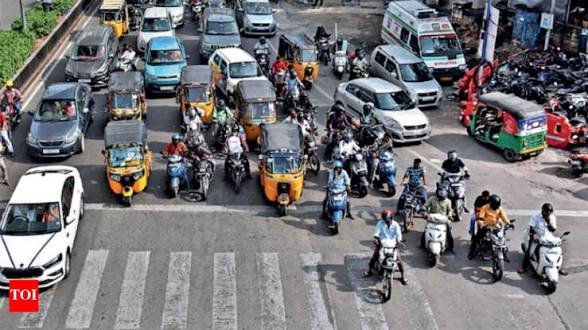
Too many junctions, uncontrolled road openings and poorly coordinated signals are killing average speeds, worsening congestion and turning everyday commutes into exhausting journeys.
Hyderabad is growing at a remarkable pace. New residential colonies, commercial hubs, IT corridors and shopping districts are expanding across the city. Yet, despite the construction of wider roads, flyovers and elevated corridors, commuters continue to experience frustratingly slow journeys. One major reason is the excessive number of junctions, cross-roads, T-junctions and uncontrolled access points on the city’s intra-city roads.
The problem is simple but often overlooked: a road cannot function efficiently if traffic is forced to stop or slow down every few hundred metres.
Many arterial roads in Hyderabad have become a succession of intersections. Vehicles travelling on the main road are constantly interrupted by traffic entering from side roads, vehicles making right turns, autos stopping abruptly, pedestrians crossing, roadside parking and poorly managed merging movements.
Even a relatively wide road loses its effective capacity when these interruptions occur repeatedly. Instead of smooth movement, commuters experience a frustrating cycle of acceleration, braking, waiting and restarting.
Average speed takes a beating
The biggest casualty of excessive junctions is average speed. A vehicle may briefly travel at 40 or 50 kmph, but repeated stoppages at signals and intersections dramatically reduce its overall speed.
A 10-kilometre journey that should ideally take 20 minutes can stretch to 40 minutes or more during peak hours. The distance remains the same, but the time lost at successive junctions makes commuting increasingly inefficient.
This stop-and-go pattern also increases fuel consumption, vehicle wear and tear, pollution and commuter stress. Thousands of motorists collectively lose enormous amounts of productive time every day.
One junction creates a chain reaction
Traffic congestion at one junction rarely stays confined to that location. When queues extend beyond the available road space, they block neighbouring intersections. Vehicles entering from side roads struggle to merge, buses become trapped, and traffic signals fail to clear the accumulated queues.
A single poorly designed junction can therefore disrupt an entire corridor.
In Hyderabad, where several major roads carry a combination of residential, commercial, office and through-traffic, closely spaced junctions are becoming a major source of bottlenecks. Road widening alone cannot solve the problem if the widened road continues to be interrupted by the same number of traffic conflicts.
Hyderabad needs junction rationalisation
The city requires a comprehensive audit of junctions on major intra-city roads. Closely spaced access points, unnecessary openings and poorly designed intersections must be reviewed and rationalised wherever feasible.
Not every residential road needs unrestricted access onto a busy arterial road. Where appropriate, minor access roads can be connected through internal streets, while traffic can be directed to safer and better-designed junctions.
Unnecessary right turns and crossing movements should also be restricted at selected locations, with properly designed alternative routes and U-turn facilities.
Signals must work together
Traffic signals should not operate as isolated installations. On major corridors, signal timings need to be coordinated to allow vehicles to move through successive intersections with fewer stops.
Modern adaptive traffic signal systems can adjust timings based on actual traffic volumes. Better coordination between traffic police, road engineering agencies and signal management systems can significantly improve corridor efficiency.
Flyovers alone are not the answer
Constructing a flyover at every congested junction is neither financially sustainable nor necessarily effective. The city must identify the most critical bottlenecks through traffic studies and consider grade separation only where justified.
At other locations, improved signal management, turning restrictions, access control, pedestrian facilities and enforcement may deliver better results at a fraction of the cost.
Roadside parking, encroachments, poorly positioned bus stops and commercial loading near junctions must also be addressed. These activities reduce road capacity and worsen congestion even when the road infrastructure itself is adequate.
A citywide mobility strategy is essential
GHMC, Hyderabad Traffic Police, HMDA and other road-owning agencies must adopt a coordinated, corridor-based traffic management strategy. The focus should be on reducing interruptions, improving connectivity and maximising the efficiency of existing roads.
Traffic performance should be measured through average speeds, queue lengths, signal waiting times, vehicle throughput and accident statistics. Citizens should be able to see whether infrastructure investments are actually improving their daily commute.
Hyderabad’s traffic crisis is not merely a problem of growing vehicle numbers. It is also a problem of road design, excessive intersections and inefficient traffic management.
The city needs roads that allow vehicles to move continuously, not roads that force commuters to stop at every crossroad. Development must be measured not by the number of roads, flyovers or junctions constructed, but by the time saved, congestion reduced and quality of life improved for its citizens.

