

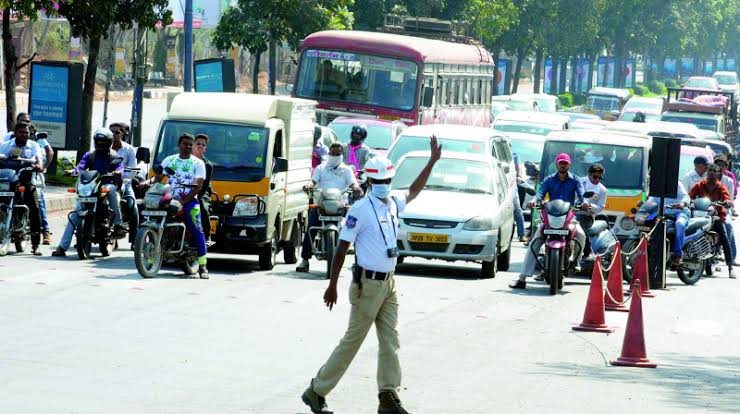
Thousands of citizens lose precious hours every day as one of Secunderabad’s busiest junctions turns into a symbol of urban mismanagement, administrative delays and public inconvenience.
Hyderabad is aspiring to become a global metropolitan city. It proudly showcases its IT infrastructure, expanding business districts, metro connectivity and growing economic opportunities. However, there is another side to this development story that thousands of ordinary citizens experience every single day: the unbearable traffic congestion at Sangeet Junction in Secunderabad.
For people travelling between Mettuguda, Tarnaka, Habsiguda, Uppal, Marredpally, Paradise and other parts of the city, Sangeet Junction has become a daily test of patience. What should be a short journey frequently turns into an exhausting exercise of waiting, honking, navigating through chaotic traffic and watching valuable time disappear.
Sangeet Junction is no longer just a traffic problem. It has become a symbol of how urban infrastructure planning is failing to keep pace with Hyderabad’s growth.
A junction that never seems to breathe
The traffic situation at Sangeet is not restricted to morning and evening peak hours. Congestion can be experienced during several parts of the day, with office-goers, school buses, college students, RTC buses, autos, private vehicles and commercial transport competing for limited road space.
A report published on August 8, 2025, highlighted that Sangeet Crossroads recorded 19,484 vehicles between 8 am and 11 am, making it the most congested junction in the dataset discussed in the report.
Commuters have also complained about signal timings that force vehicles to wait through multiple cycles before crossing the junction.
The consequences are enormous:
- Employees struggle to reach offices on time.
- Students face unnecessary delays in reaching educational institutions.
- Patients travelling to hospitals experience avoidable difficulties.
- Public transport passengers spend excessive time inside buses.
- Senior citizens and pedestrians face safety challenges.
- Fuel consumption increases as vehicles remain stationary or move slowly.
- Mental stress, frustration and road rage become part of everyday commuting.
For thousands of Hyderabad residents, reaching their destination on time has become a matter of uncertainty rather than proper planning.
Government promises versus ground realities
The bigger question is: Why has a major traffic bottleneck like Sangeet Junction continued to trouble citizens for so long?
Successive administrations have been aware of the congestion. Urban traffic problems are not new, and the need for junction improvements has been discussed for years.
Even in 2020, proposals were reported for improving Sangeet and nearby Maredpally junctions through road widening and other infrastructure interventions.
In January 2024, Chief Minister A. Revanth Reddy directed officials to prepare a comprehensive traffic management plan for Hyderabad. The government announced measures involving traffic personnel, road expansion and feasibility studies for underpasses and other infrastructure.
Yet, the question citizens continue to ask is simple: How much of this planning has translated into visible relief at Sangeet Junction?
In October 2026, the Malkajgiri Municipal Corporation Commissioner inspected Sangeet Junction and directed officials to prepare a blueprint examining possibilities such as a free left turn and road widening.
While this is a welcome development, it also raises questions about why a comprehensive, time-bound solution has taken so long to materialise. The announcement is currently at the blueprint and assessment stage, rather than a completed infrastructure intervention.
Citizens deserve implementation, not another round of inspections, meetings and proposals.
Why is Sangeet Junction becoming increasingly unbearable?
Several factors contribute to the problem.
1. Inadequate road infrastructure
The existing road infrastructure is under tremendous pressure from increasing vehicle numbers. Road capacity and junction design must reflect present-day traffic requirements rather than outdated assumptions.
2. Poor junction management
Traffic signals, turning movements and vehicle queues need to be scientifically coordinated. Poorly managed turning points can create congestion across multiple connecting roads.
3. Free-left bottlenecks
A free-left movement that is blocked or poorly designed can disrupt traffic flow. Dedicated, unobstructed turning lanes could significantly improve movement wherever technically feasible.
4. Pedestrian safety
Pedestrians, particularly schoolchildren and elderly citizens, need safe crossing facilities. A road system that prioritises vehicles while neglecting pedestrians creates additional risks.
5. Lack of coordinated planning
Traffic police, municipal authorities, transport agencies and road infrastructure departments must work together. Isolated interventions cannot solve a problem that involves multiple connecting roads.
The hidden economic cost of traffic congestion
Traffic congestion is not merely an inconvenience. It directly affects the city’s economic productivity.
Imagine thousands of employees losing 20–30 minutes every day at one junction.
Multiply that by hundreds of working days and thousands of commuters.
The accumulated loss of productive hours is enormous.
Companies expect employees to maintain punctuality and productivity, but the city’s infrastructure often makes these expectations difficult to meet.
Small business owners lose valuable working time. Delivery vehicles experience delays. Public transport becomes less reliable.
Ultimately, ordinary citizens pay the price for inadequate urban planning.
What should the Telangana government do immediately?
The government should move beyond temporary traffic regulation and develop a comprehensive, measurable solution.
The following interventions deserve priority:
1. Prepare a comprehensive traffic engineering study
Conduct a detailed traffic-volume assessment covering all approaches to Sangeet Junction during morning, afternoon and evening hours.
2. Implement a scientifically designed free-left system
Examine dedicated free-left lanes and ensure that they remain free from vehicle parking and other obstructions.
3. Examine flyover and underpass feasibility
Evaluate whether a flyover, underpass or grade-separated solution is technically, economically and environmentally feasible.
4. Widen roads wherever possible
Identify encroachments, examine land acquisition requirements and improve available road space.
5. Optimise traffic signals
Introduce adaptive signal management based on real-time vehicle density instead of relying entirely on fixed signal timings.
6. Improve public transport integration
Ensure that RTC buses, bus stops and passenger boarding arrangements do not unnecessarily obstruct traffic movement.
7. Provide pedestrian infrastructure
Create safe pedestrian crossings, accessible footpaths and properly designed median openings.
8. Establish accountability and deadlines
Publish a detailed project report, estimated expenditure, implementation schedule and responsible departments.
Most importantly, citizens should be informed about the progress of the project through regular public updates.
Hyderabad deserves better
Hyderabad’s development cannot be measured only through flyovers, IT parks, commercial buildings and investment announcements.
A truly developed city is one where an ordinary employee can reach the workplace without spending an unreasonable amount of time in traffic, where students can travel safely, where ambulances can move without obstruction and where senior citizens do not have to struggle to cross busy roads.
Sangeet Junction represents a larger urban governance challenge. The city is growing rapidly, but its road infrastructure and traffic management systems must evolve at the same pace.
The Telangana government and the concerned municipal authorities must recognise that traffic congestion is not a minor civic complaint. It is an issue affecting public health, economic productivity, road safety and the quality of life of ordinary citizens.
The October 2026 inspection and proposed blueprint are a step towards addressing the problem. However, citizens need to see actual improvements on the ground, with clear deadlines and measurable outcomes.
A question the government must answer
How many more years should Hyderabad’s citizens spend their valuable lives waiting at Sangeet Junction?
How many more inspections, proposals and feasibility studies are required before commuters experience meaningful relief?
Hyderabad citizens are not asking for luxury infrastructure. They are asking for basic urban mobility, responsible governance and the right to travel without daily traffic misery.
Sangeet Junction must stop being a daily nightmare and become an example of how a government can respond effectively to the genuine problems of its citizens.
The people of Hyderabad deserve action, not assurances.

