

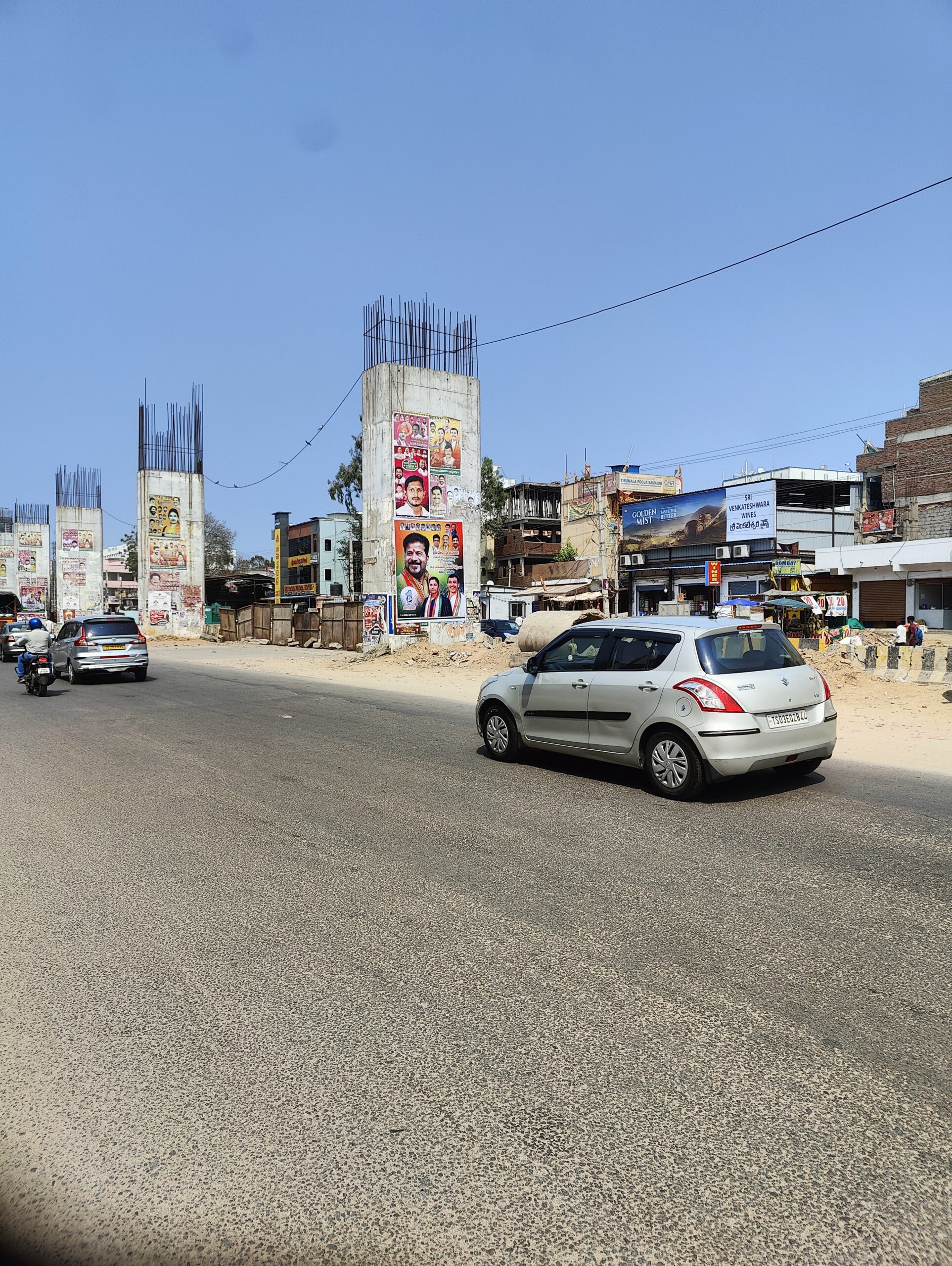
The Uppal-Narapally elevated corridor, one of Hyderabad’s most talked-about infrastructure projects, was conceived nearly a decade ago to relieve heavy traffic on the busy NH-163 corridor linking Uppal to Narapally. However, what was envisioned as a three-year construction project has turned into a long saga of delays, public frustration and repeated timelines that keep shifting.
A Project with a Long History of Delays
Work on the six-lane, roughly 6.2 km long flyover started back in 2018 with an estimated budget of around ₹675 crore and an expected completion timeframe of around 18 months. Since then, progress has lagged far behind that initial schedule.
Several factors have contributed to the slow pace of work:
Land acquisition hassles, shifting of utilities such as power and water lines, and coordination issues between agencies have repeatedly slowed work.
Problems with the original contractor and poor progress led to intervention by senior officials, including a directive to replace the contractor to speed things up.
Redesigns linked to clashes with other infrastructure projects, like metro viaduct alignments, also pushed timelines.
An RTI from 2023 showed that less than half the project had been completed even then, and local commuters have faced rough road conditions, dust and congestion as a result.
Government Promises vs. Ground Reality
Officials have repeatedly set new targets for completion:
Roads & Buildings Minister Komatireddy Venkat Reddy has publicly stated that authorities are aiming to finish the project by Dasara 2026, a major festival in October.
Government sources also suggested that with renewed focus and closer monitoring, work would accelerate significantly in 2025–26.
Despite these assurances, progress on the ground remains patchy. A news report from late 2025 described the corridor as “lagging far behind schedule,” with major milestones like foundations still being laid just months before the supposed deadline.
Residents and commuters, who have endured years of dust, potholes and hazardous traffic conditions, doubt that such an ambitious timeline can be met given what is still incomplete on the site. Informal online discussions among locals reflect widespread scepticism about whether the flyover will really open to traffic by late 2026 — with some likening it to a long-running project that feels “never-ending.”
Technical and Logistical Challenges Still to Clear
Even with renewed political focus, substantial construction tasks remain:
Pillar construction and segmental spans (the lengths of road between supports) still need to be completed over large stretches.
Traffic diversions are only now being planned on the main Uppal road to facilitate construction, indicating that major execution is still in progress.
Land acquisition efforts continue to require close coordination among civic and planning departments.
Will It Be Ready by October 2026?
Given the complexity of work that remains — from finishing the elevated road surface to installing safety and lighting systems — many experts and residents feel the October/Dasara 2026 deadline is highly optimistic, if not unlikely. Although the government has reiterated its commitment to that timeline, significant portions of the project are still in early or middle stages of construction, and unexpected delays (weather, supply chain issues, labour availability) could further push back completion.
On the other hand, with focused execution, contractor accountability, and better inter-agency coordination, it is technically possible for the bulk of the flyover to be finished by late 2026 — but this would require a sharp acceleration in progress over the next several months.
Conclusion
The Uppal-Narapally flyover illustrates the challenges of delivering major infrastructure projects in growing urban regions: bureaucratic hurdles, design changes, contractor issues and evolving timelines can combine to delay benefits to commuters for years.
While authorities have pledged a final push to meet the 2026 target, the project’s past pace and residents’ scepticism suggest that meeting it won’t be easy — and underscoring the need for more transparent reporting on on-site progress as the deadline approaches.

